Always Bad for the Democrat

Jamison Foser takes a look back to the most recent legitimately questionable use of the reconciliation process, the Bush tax cuts, to gauge what must have been a veritable torrent of “end of democracy” style editorials and hard-hitting analytical articles and investigations. Right?

The Senate reconciliation vote occurred on May 23, 2003. In the month of May, only one New York Times article so much as mentioned the use of reconciliation for the tax cuts — a May 13, 2003, article that devoted a few paragraphs to wrangling over whether Senate Republicans could assign the bill number they wanted (S.2) to a bill approved via reconciliation. The Times also used the word “reconciliation” in a May 9, 2003, editorial, but gave no indication whatsoever of what it meant.

And that’s more attention than most news outlets gave to the use of reconciliation that month. The Washington Post didn’t run a single article, column, editorial, or letter to the editor that used the words “reconciliation” and “senate.” Not one. USA Today, the Los Angeles Times, and the Associated Press were similarly silent.

Cable news didn’t care, either. CNN ran a quote by Republican Sen. Chuck Grassley about the substance of the tax cuts in which he used the word “reconciliation” in passing — but that was it. Fox News aired two interviews in which Republican members of Congress referred to the reconciliation process in order to explain why the tax cuts would be temporary, but neither they nor the reporters interviewing them treated reconciliation as a controversial tactic.

And ABC, CBS, NBC? Nothing, nothing, nothing.

Yep. This time around? Well, that’s totally different, of course:

the media are referring to reconciliation as the “nuclear option” and portraying it as an obscure procedural gimmick being considered in an attempt to circumvent Senate rules and “ram” health care legislation through Congress. The conservative media are going so far as to claim that use of reconciliation would be “unprecedented.”

The Democrat has got to work on its messaging. It’s all that matters. The GOP has sewn the earth with salt re: governance and, really, any sense of shared civic concern whatsoever for over two decades. Any chance to poison the perceived relationship between citizen and government has been used to reassure the populace that government never, ever can provide anything to the governed that couldn’t be better provided by the private citizen.
An equally ferocious, equally long-term effort will be required to reacquaint people with the everyday things that evil big government is doing for them. Most of which are directly enabling enraged GOP voters to live the solitary, exurban lifestyles that make up so much of the current GOP base. That the western “Red” states are livable at all: entirely the result of government spending and ostentatiously generous water policy. Period. That no one living in those states seems to realize this: the fault of the Democrat, and dangerous for the country. This (and messaging on a thousand issues just like it), more than anything, needs to be rectified. And soon.
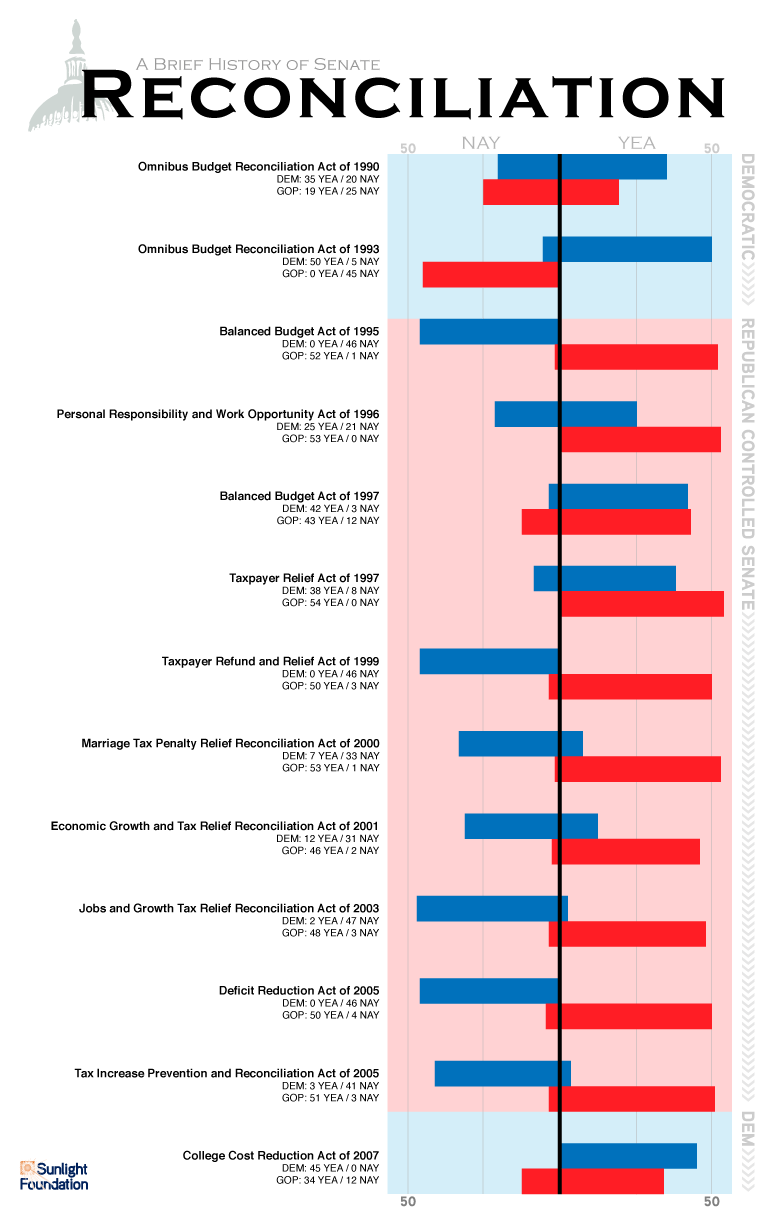
In an op-ed in Tuesday’s Post, Sen. Orrin Hatch (R-Utah) offered an excellent example of this hypocrisy. Right off, the piece was wrong on a core fact. Hatch accused the Democrats of trying to, yes, “ram through the Senate a multitrillion-dollar health-care bill.”

No. The health-care bill passed the Senate in December with 60 votes under the normal process. The only thing that would pass under a simple majority vote would be a series of amendments that fit comfortably under the “reconciliation” rules established to deal with money issues. Near the end of his column, Hatch conceded that reconciliation would be used for “only parts” of the bill. But why didn’t he say that in the first place?

Hatch grandly cited “America’s Founders” as wanting the Senate to be about “deliberation.” But the Founders said nothing in the Constitution about the filibuster, let alone “reconciliation.” Judging from what they put in the actual document, the Founders would be appalled at the idea that every major bill should need the votes of three-fifths of the Senate to pass.

[…]

Hatch said that reconciliation should not be used for “substantive legislation” unless the legislation has “significant bipartisan support.” But surely the 2001 and 2003 Bush tax cuts, which were passed under reconciliation and increased the deficit by $1.7 trillion during his presidency, were “substantive legislation.” The 2003 dividends tax cut could muster only 50 votes. Vice President Dick Cheney had to break the tie. Talk about “ramming through.”

Comprehensive health care reform will not work through reconciliation. But if the House passes the Senate bill, and wants certain things improved on, like affordability, the Medicaid provisions, how much of Medicaid expenses are paid for by the Federal government, that is something that could be done through reconciliation.
A sidecar would be a good candidate for reconciliation depending on what’s in it,
The only thing that works here is the House has to pass the Senate bill, then the House can initiate a reconciliation measure that would deal with a limited number of issues that score for budget purposes.

Kent Conrad (~D, ND) and (clearly) a friend to Lemkin

Thus by my admittedly simple classification scheme, this would suggest that 14 of the 19 times reconciliation was used between FY1981 – FY2005, it was used to advance Republican interests. Or, to put this more precisely, it was used to advance bills that were signed by Republican presidents or vetoed by Democratic presidents.

Memo to Code Brown 2: Judgement Day

Scott Brown, local imbecile, said through a spokesman yesterday that:

If the Democrats try to ram their health-care bill through Congress using reconciliation, they are sending a dangerous signal to the American people that they will stop at nothing to raise our taxes, increase premiums and slash Medicare. Using the nuclear option damages the concept of representative leadership and represents more of the politics-as-usual that voters have repeatedly rejected.

The problem is that using reconciliation is neither “the nuclear option” (that’d be this, a technique both invented and brandished by one Grand Old Party) nor is the use of said reconciliation in any way unprecedented, either in terms of budgetary measures (precisely the reason the damned thing was created in the first place) or healthcare reforms (which often are entirely or nearly entirely budgetary issues). NPR provides us with a partial listing of the many uses of reconciliation in recent years:

  1. 1982 — TEFRA: The Tax Equity and Fiscal Responsibility Act first opened Medicare to HMOs

  2. 1986 — COBRA: The Consolidated Omnibus Budget Reconciliation Act allowed people who were laid off to keep their health coverage, and stopped hospitals from dumping ER patients unable to pay for their care

  3. 1987 — OBRA ‘87: Added nursing home protection rules to Medicare and Medicaid, created no-fault vaccine injury compensation program

  4. 1989 — OBRA ’89: Overhauled doctor payment system for Medicare, created new federal agency on research and quality of care

  5. 1990 — OBRA ’90: Added cancer screenings to Medicare, required providers to notify patients about advance directives and living wills, expanded Medicaid to all kids living below poverty level, required drug companies to provide discounts to Medicaid

  6. 1993 — OBRA ’93: created federal vaccine funding for all children

  7. 1996 — Welfare Reform: Separated Medicaid from welfare

  8. 1997 — BBA: The Balanced Budget Act created the state-federal childrens’ health program called CHIP

  9. 2005 — DRA: The Deficit Reduction Act reduced Medicaid spending, allowed parents of disabled children to buy into Medicaid

Conveniently left off that list are several that are specifically damaging to the GOP’s case for grievance here. Like both of the Bush tax cuts. Reconciliation. Additional oil drilling courtesy of W. Reconciliation. Medicare Part D (aka W Bush’s unfunded cost explosion). Reconciliation. Various W trade authorities. Reconciliation. And, of course, there’s this hypocrisy that’s never mentioned by the MSM:

the very senators who speak reverentially of the filibuster now, voted for reconciliation then. Judd Gregg, in fact, voted for reconciliation every time it was used in the Bush era.