How not to succeed in academia

A magnificently honest, accurate portrayal of life in science…and coming to realize it is time to walk away from same:

So, what went wrong? There are a great many alluring things about an academic scientist’s lifestyle that are simultaneously liberating and dangerous. The best of these are that you can work pretty much whenever you like, on whatever is interesting; the flip side is that “whenever you like” often translates into “all the time,” and “interesting” is a matter of who you’re talking to. For the first 5 years or so, I loved the freedom of being a scientist in what was touted as a meritocracy. I did work very hard, and I got somewhere […]

However, I was always hampered by self-doubt. My initial conviction – essential for anyone who wants to make it as a scientist – that I could really make a difference, maybe even win a few prizes and get famous, eroded when I realized that my brain was simply not wired like those of the phalanx of Nobelists I met over the years; I was never going to be original enough to be a star. This early realization, combined with a deep-seated lack of self-confidence, meant that I was useless at self-promotion and networking. I would go to conferences and hide in corners, never daring to talk to the speakers and the big shots. I never managed, as an infinitely more successful friend put it, “to piss in all the right places.”

All I have to say to that is: yep. Painful but (usually) true. The realization is half the battle. There’s a nice little career to be had while not being a shatteringly important thinker in your field. At least I hope there is…

via commonunity
How not to succeed in academia

[My study] found the exposure [from millimeter wave scanners] to be about one-fiftieth to one-hundredth the amount of a standard chest X-ray. [I] calculated the risk of getting cancer from a single scan at about 1 in 30 million, which puts it somewhat less than being killed by being struck by lightning in any one year, [and] while the risk of getting a fatal cancer from the screening is minuscule, it’s about equal to the probability that an airplane will get blown up by a terrorist.

Peter Rez, a physicist and professor at Arizona State University. This is exactly the way we should be talking about this. You are trading one minuscule risk for another, and are doing so with no measurable impact on the overall risk in terms of either health or the likelihood that you can actually even interdict an attack with this stupid machine.
Hey hey, hey ho: porno-scanners have got to go. And etc…

This is a news article about a scientific paper

This is the descriptive tag for my excerpt that I include such that you will (hopefully) click on through:

To pad out this section I will include a variety of inane facts about the subject of the research that I gathered by Googling the topic and reading the Wikipedia article that appeared as the first link.

I will preface them with “it is believed” or “scientists think” to avoid giving the impression of passing any sort of personal judgement on even the most inane facts.

This fragment will be put on its own line for no obvious reason.

This is a news article about a scientific paper

Well, creationism, in essence, is believing that the world began as the Bible in Genesis says, that God created the Earth in six days, six 24-hour periods. And there is just as much, if not more, evidence supporting that.

Christine O’Donnell, on Evolution theory.

Pills of the [antimony] became popular as a medicine in the 1700s, especially as a laxative, able to blast through the most compacted bowels. It was so good the chronically constipated would root through their excrement to retrieve the pill and reuse it later. Some lucky families passed down antimony laxatives from generation to generation.

Sam Kean, blogging the periodic table over at Salon. Oh what I wouldn’t give for the simpler days of yore when we really cared about families and knew what mattered. Specifically, sifting our shit for Papa’s prize poison pill. You can just taste the love.

[W]hen people thought the earth was flat, they were wrong. When people thought the earth was spherical, they were wrong. But if you think that thinking the earth is spherical is just as wrong as thinking the earth is flat, then your view is wronger than both of them put together.

NYT:

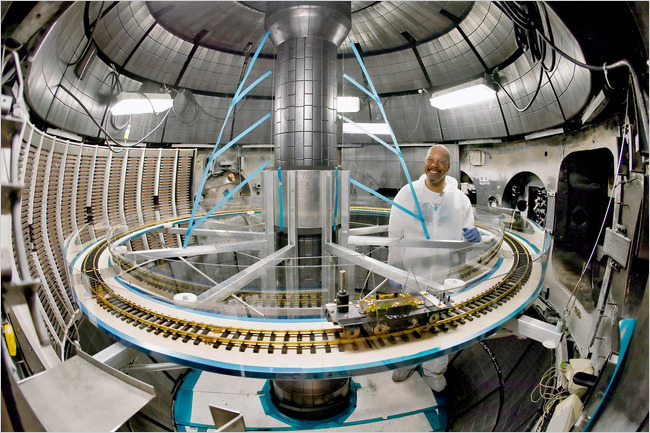
This month, at the Princeton Plasma Physics Laboratory, physicists and engineers built [model train] tracks inside one of its fusion reactors and ran a toy train on them for three days.
[…]

The modified model of a diesel train engine was carrying a small chunk of californium-252, a radioactive element that spews neutrons as it falls apart.

“We needed to refine the calibration technique to make sure we are measuring our neutrons as accurately as possible

Awesome.