

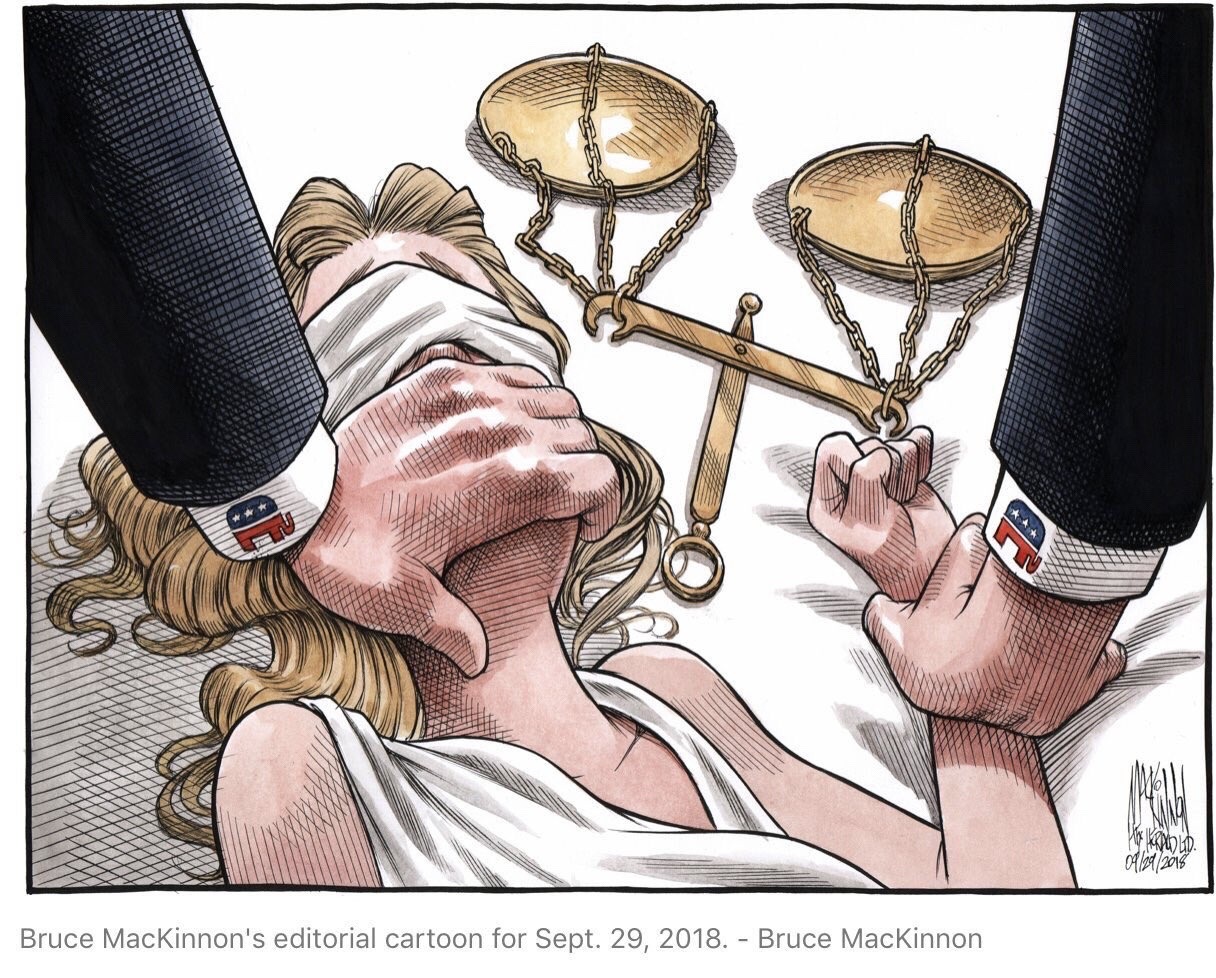
Even if it’s all true, does it disqualify him?
I really don’t understand the Democratic messaging problem here. Every Democrat from dog catcher to Senate Minority leader only needs to remember three words: “Merrick Fucking Garland.” Repeat any time a microphone is near. He is the only acceptible nominee for this or any seat on the court until he is seated. Period. The fucking end. Anything else is window dressing and a needless and message-diluting distraction. After Garland is ensconced, we can start to talk about the legitimacy of any Trump nominee for any position, assuming the Orange Man isn’t already in jail by then.
There should be at least 1 million people surrounding the Capitol right now with one simple demand: Garland is seated or no one leaves this building. These are the messages that the modern GOP can and will understand.
Opinion | Inside the coming campaign to block Trump’s Supreme Court pick
McConnell’s head for a hearing?
Call it an hypocrisy tax. It could be the first tax that all Americans love.
Well reasoned article by Kurt Eichenwald, starts thusly:
Gorsuch [though well qualified in terms of the “traditional norms”], unfortunately, must be sacrificed on the altar of obscene partisanship erected by the Republicans in recent years. Temper tantrums designed to undermine the Constitution for naked political purposes cannot be rewarded. Our government cannot survive the short-term games-playing that has replaced fidelity to the intent of the Founding Fathers’ work in forming this once-great nation.
But I have to say, his solution is an odd one, basically force a vote on Garland, which, of course, would simply be a party-line “no” based on the current Senate, then renominate Gorsuch:
So even though Garland would not have won a Senate confirmation vote, a precedent needs to be established: the Senate’s confirmation responsibilities under the Constitution are not a joke, are not something where absurd rationalizations that pass for smarts on Fox News can be used to circumvent history and precedent. Nominees must be given hearings and votes. And yes, if that means letting the Republicans blow up the filibuster, let them do it.
Honestly, I don’t see how that’s “punishment” or is in any way reseting the Constitutional norms. His final paragraph, however, does break the glass on what I would definitely agree is true and lasting retribution for this act (and that also presumes the inevitable end of judicial filibusters he alluded to above):
Then, when a Democratic president is in office, the Democrats control the Senate, and there is no filibuster, show the Republicans a real exercise in raw power: revive Franklin Roosevelt’s plan to pack the Supreme Court and fill it with the most liberal justices around. If the Republicans insist on turning the judiciary into a political plaything, play the roughest game of hardball they have ever seen.
That is nothing if not serious hardball. It is amazing to see it suggested in print by someone like Eichenwald. Trump voters wanted change. They’re getting change alright.
Eichenwald: Neil Gorsuch is supremely qualified, and must not be confirmed
Geoffrey Stone makes as good a case as I’ve seen:
Anyone who cares about the proper and legitimate functioning of our American democracy must oppose Judge Gorsuch’s nomination, not because he is necessarily unqualified, but because of the undermining of our American democracy by Senate Republicans. Anyone who cares about the rule of law should must oppose this nomination. If we fail to take this stand, the Senate Republicans will have succeeded in placing a justice onto our highest Court who has no business being there. They will have undermined the credibility of the Supreme Court as an institution, an institution that is critical to the functioning of our Constitution.
Judge Gorsuch’s nomination should be withdrawn, and the President should nominate in his place a genuinely moderate justice who is acceptable to Democrats and Republicans alike. Only then can we move on with a sense of institutional integrity. Short of that, every decision of the Court decided by a margin of five-to-four with Neil Gorsuch in the majority will justifiably be castigated as fundamentally illegitimate.
Simply saying you’re holding the seat for at least four years isn’t going to fly. Preemptively declaring a blanket filibuster on all candidates isn’t going to fly; that sort of thing is perfectly okay if you’re a Republican, but otherwise you can forget about it. But the Democrats must find a way to extract a political price over the Garland theft, but have to do so in a “serious” way that also placates the recently ascendant Democratic wing of the Democratic Party. Maybe you can manage to hold until mid-terms? But you have to have an end game and start talking about it today; good thing the Democrats are known for their excellent coordinated messaging machine…
Sorry, Neil Gorsuch. The Supreme Court Seat Was Already Filled
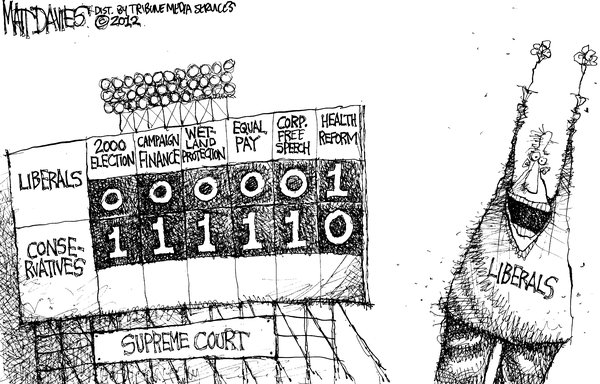
Matt Yglesias makes a strong case re: the likely philosophical underpinnings of Roberts’ joining the more liberal members of the court to uphold the mandate. Namely that, in the absence of mandate, the Democrats would begin campaigning for Medicare for All. And they’d get it. Maybe not today, maybe not tomorrow, but almost certainly within a millennium or two, and then for a long time.
But! I don’t think nearly that long of a game is needed, though. Presuming Roberts was never going to gut the whole bill, knocking out just the mandate within the political system as currently figured does nothing so well as guarantee the end of the private insurance system we all know and love within 5 or 10 years. This is because, without a mandate, healthy individuals would have powerful incentive not to buy insurance until they are sick. Since the ACA already prevents insurers from refusing coverage for any reason, you’d simply buy insurance on the day you started needing it. That is, to say the least, an unsustainable business model. Some even called for a “poison pill” in the original law designed to create this situation such that even a GOP government would be forced into extending Medicare to all the moment even their constituents could no longer afford insurance premiums.
Roberts knew all of this. He knew he likely couldn’t simply gut the law without adversely affecting the public’s opinion of the Supreme Court in general and the Roberts court in particular, knew he furthermore couldn’t simply kill the mandate without also killing private insurance (gridlock essentially ensured this outcome), and decided the least of these was simply keeping the mandate and letting Congress sort it out. Which, as it happens, was exactly the right decision by any reading of the Constitution and precedent that my not-a-lawyer eyes can detect. Huzzah for democracy.
In Plain English: The Affordable Care Act, including its individual mandate that virtually all Americans buy health insurance, is constitutional. There were not five votes to uphold it on the ground that Congress could use its power to regulate commerce between the states to require everyone to buy health insurance. However, five Justices agreed that the penalty that someone must pay if he refuses to buy insurance is a kind of tax that Congress can impose using its taxing power. That is all that matters. Because the mandate survives, the Court did not need to decide what other parts of the statute were constitutional, except for a provision that required states to comply with new eligibility requirements for Medicaid or risk losing their funding. On that question, the Court held that the provision is constitutional as long as states would only lose new funds if they didn’t comply with the new requirements, rather than all of their funding.
 Lemkin