
It’s a self-eating watermelon of despair.
Adam Steltzner, leader of the entry, descent, and landing team for the Curiosity mission, describing the difficulties of scaling an airbag-based landing system.
It’s a self-eating watermelon of despair.

Note to self: do not release a mole of moles onto the surface of the Earth. Oh, and this is how introductory science, nay, introductory everything should be taught.
“There is an asteroid, discovered in December 2004, called Apophis. Named for the Egyptian god of death and darkness. It was named only after its trajectory was identified to intersect that of Earth… Turns out, in the year 2029, in the month of April… Apophis will come so close to Earth that it will dip below our orbiting communications satellites. And it is the size of the Rose Bowl. It will be the largest, closest thing we have ever observed to come by Earth. The orbit we now have for it is uncertain enough—because these things are hard to measure and hard to get an exact distance for—that we cannot tell you exactly where that trajectory will be. We know it won’t hit Earth, but we know it will be closer than the orbiting satellites. There is a range, a 600-mile zone, called the keyhole. If the asteroid goes through the middle of the keyhole, it will hit the Earth 7 years later. It will hit the Earth 500-kilometres west of Santa Monica. Now, that’s if it goes through the centre [of the keyhole]; if it goes through the centre, it hits the Pacific Ocean, plunges down into the Pacific to a depth of 3 miles, at which point it explodes, cavitating the Pacific in a hole that’s 3 miles wide, three 3 deep. That will send a tsunami wave outward from that location that’s 50 feet high. 5 storeys.”
—
Neil deGrasse Tyson, Revolving & Evolving (via cocknbull)
um.
NASA begs to differ:
Using criteria developed in this research, new measurements possible in 2013 (if not 2011) will likely confirm that in 2036 Apophis will quietly pass more than 49 million km (30.5 million miles; 0.32 AU) from Earth on Easter Sunday of that year (April 13).
Much more at the NASA link.
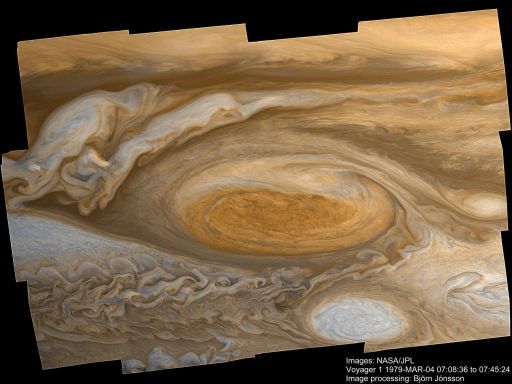
Amateur re-processes Voyager images of Jupiter to great effect:
The images I used were obtained on March 4, 1979 at a distance of about 1.85 million kilometers. The first image (C1635314.IMQ) was obtained at 07:08:36 and the last one (C1635400.IMQ) at 07:45:24. The resolution is roughly 18 km/pixel.
The detail present in the full-size version is amazing.
And so it’s come to this. Mighty Jupiter is reacting negatively to the radical socialist agenda that Obama has been forcing on an unsuspecting ‘Merica:
Jupiter has lost one of its prominent stripes, leaving its southern half looking unusually blank. […] Jupiter’s appearance is usually dominated by two dark bands in its atmosphere – one in the northern hemisphere and one in the southern hemisphere.
But recent images taken by amateur astronomers show that the southern band – called the south equatorial belt – has disappeared.
Naturally, the last time this happened was when Jupiter reacted to warn Our Country of the coming Carter presidency. Failing to heed mighty Jupiter, America went on to elect history’s greatest monster, Jimmy Carter. And we all know how that turned out.
Let’s review the evidence. Jupiter before Obama:

and the tragically denuded, post-Obama Jupiter:

As per usual, the administration’s response to Jupiter is slow; sources in the White House confirm that response, when it finally comes, will be largely centered around temporarily adding an Islamic crescent to Jupiter’s mighty countenance in the hopes of appeasing Obama’s sharia task-masters.
No matter how it plays out now, though, this celestial incident is definitely shaping up to be Obama’s Shoemaker-Levy 9, and his lack of an effective response or even any apparent planning for this event will doom him just as surely as that comet doomed both the Clinton presidency and the then nascent Gore campaign, which took a notably earth-toned, four-buttoned position on the bands of Jupiter, one which the American public wasn’t ready for.
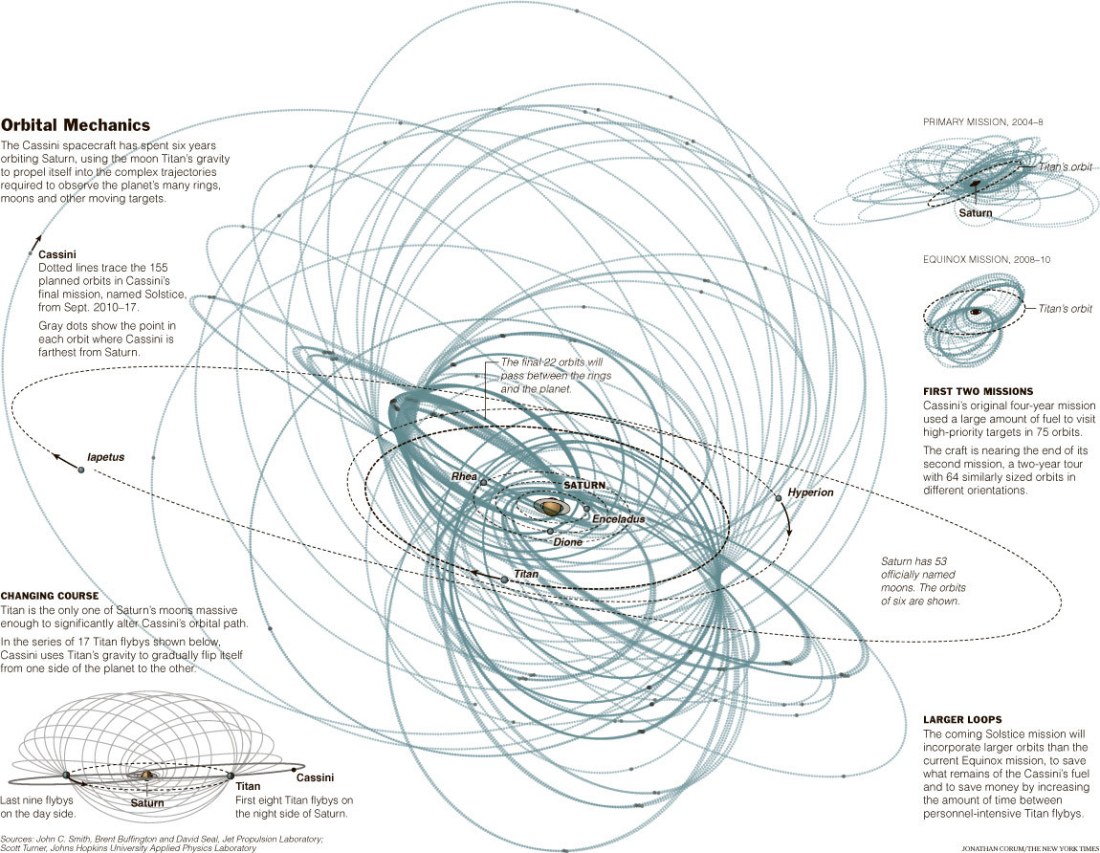
The government blows it again; Cassini mission extension lasts seven years (that’s seven years beyond the already extended six years of service, itself two years longer than anyone anticipated. In orbit around Saturn.)
The final “reference trajectory” calculates all the course corrections and various gravity-assisted adjustments, tracking through those seven years, all the while correlating scientific goals with manpower and funding availability. Out seven years. This path “includes 56 passes over Titan, 155 orbits of Saturn in different inclinations, 12 flybys of Enceladus, 5 flybys of other large moons.” Then the probe will fly into Saturn and be destroyed.
Is there nothing this government can do right?
It’s not every day one gets to write a paper that includes such excerpts as:
[the] structure would be assembled in space near the sun by an army of robots and built out of space-based materials
while talking about small black holes, Dyson spheres, and the possibility of re-purposing SETI as a means of detecting the telltale gravitational waves of and/or the gamma emissions from poorly collimated exhaust of ships built to these theoretical specifications. But, when you do touch on all that, you generally get to include this line:
In the epilogue, we discuss possible philosophical ramifications of this observation.
Science!
Incidentally, in the 23rd century, Scotty frequently raged about this part of the paper:
A microscopic particle of ordinary matter which drifted into the antimatter would cause an explosion, scattering the antimatter into contact with the ship, and destroying everything for millions of miles around.
while (typically and completely) ignoring this part:
Any electromagnetic force which held the antimatter in would also drive normal matter in.
Best to stay the hell away from the Engineering deck, then. Somewhere on the order of millions of miles away. Good to know. <hand_gestures> Good. to. know! </hand_gestures>
John Glenn, first American man to orbit the Earth, on the upcoming interregnum in America’s spacefaring capacity:
“I never thought I would see the day when the world’s richest, most powerful, most accomplished spacefaring nation would have to buy tickets from Russia to get up to our station,”
Umkay. I hear that India is in the Space Station market. Just give them the damned thing. That’ll leave them significantly less money for ongoing nuclear development…
I’m all for teh Space Science and all, but that thing is a free-fall to nowhere in particular and costs ~$1bn per shuttle launch (setting aside for the moment the 1 in 50 potential for the death of seven, count ‘em, SEVEN astronauts) to even get a refrigerator up there.
I say we go robotic and do all of our ant farms studies on the good Earth until the next ride arrives. We did the same throughout most of the 70s and the Republic is still here.

 Lemkin