This is how The End begins

So, at least now we know how it all ends for Microsoft:

SEATTLE — In the biggest shuffling of Microsoft’s executive ranks since the company’s new chief executive, Satya Nadella, took over, Mark Penn, the former aide to the Clinton family, is becoming the company’s chief strategy officer.

The change will give Mr. Penn, who has been an executive vice president at Microsoft overseeing advertising and strategy, a bigger hand in determining which markets Microsoft should be in and where it should be making further investments

Inexplicable. He’ll have that company destroyed inside of a month. Well, more destroyed.

This is how The End begins

Faceplant

Sergey Brin: [Smartphones are] emasculating. You’re standing around and just rubbing this featureless piece of glass.
John Gruber: I can see the argument that dicking around with our phones in public is not cool, that we should pay more attention to our companions and surroundings, and less to our computer displays. Strapping a computer display to your face is not the answer.
Lemkin: Yep. File Google Glass away with “Because everything is waterproof, the housewife of the future will clean the living room with a hose.”

Why You Should Ignore the Verge (in 44 words or less)

Josh Topolsky: I am now responding to Marco Arment, John Gruber, and anyone else who sets up a minimal WordPress blog and thinks that the ability to publish text onto the internet gives them insight into what journalism is or what I do for a living.
Businessweek: John Gruber makes an estimated $500,000 a year from his [minimal WordPress] blog Daring Fireball. [But, let’s face it, how can he possibly know about or even have passing insight into real journalism such as that practiced The Industry Leader (and daily lesson for us all), The Verge.com?]

King of Content

Predictably thoughtful take from John Gruber on the broader tablet strategy that Amazon is taking up in light of the new Kindle/Kindle Fire product line. You should read the whole thing, but a couple of points really stand out. First:

Apple’s primary business is selling devices for a healthy profit, and they back that up with a side business of selling digital content for those devices. Amazon’s primary business is as a retailer, including as a retailer of digital content. They back that up with a side business of low-cost digital devices that are optimized for on-the-fly purchasing of anything and everything Amazon sells.

This is exactly right. I’d extend the idea all the way out to its limit: Amazon should buy Qwikster from Netflix.
While this move would, to Netflix, be akin to selling Babe Ruth to your direct competitor for a few grand and a bag of balls, what other company out there understands shipping better than Amazon, has a built-in pipe for selling overstocked used discs of yesterday’s blockbuster movie, could seamlessly merge the “this isn’t available to stream, shall we ship it to you right now” experience, and, most importantly, has the leverage with the content owners to actually, you know, offer a lot of content from their streaming service? Clearly the answer ain’t Netflix. It’s Amazon, who can go to content-owners and say: “Do you really want Apple to dominate your pipeline to the consumer? We have the customers, data about those customers, and the access to them. Use us a leverage against Apple and we’ll give you a marginally richer cut in exchange.” Even in an era of increasing disintermediation, the Apple model shows quite strongly that if you pile up enough content that people want, it’s ultimately easier to sell from those fewer, larger silos. Nobody wants to search ten sites to figure out which has Transformers 18: This Time It’s Personal available to stream this week only to have said stream expire mid-movie because you had to pause it at an inopportune moment. In that model, T18:TTIP pirated torrents become king. And yet this is fairly precisely the situation we consumers and our content-overlords increasingly find ourselves in. The future is most definitely not 35 separate “Apps for that,” each of which has to be painstakingly consulted on movie night. There’s room for two, maybe three, giant content aggregators. As of today, I’d say one of them is pretty obviously Apple. The other sure seems likely to be Amazon; even more likely once they’ve sold a few million Kindle Fires. Hell, since Netflix likely won’t sell a direct competitor the keys to Quikster, Bezos should just buy both Quikster and Netflix, re-brand the sexily named “Amazon Instant Video” service Netflix and milk the Quikster “physical media” approach for as long as it makes sense to do so (as part of a broader package ultimately tied to Amazon Prime membership…which, of course, is mostly a deal-sweetening mechanism designed to drive unrelated sales for Amazon as a whole). As always: fewer choices for the consumer means more money for the provider; you draw them in with the enticing product or service, then completely empty their pockets on all the other stuff they hadn’t previously even thought of buying. It’s precisely Apple’s strategy, but attacked from the perspective of the content instead of the device.

Interesting point two:

Amazon is a data-driven company. I’ll bet the $40 premium [for a Kindle that never serves you “offers”] is based on how much money they expect to make from the ads they sell and products they promote via the special offers. Last year the special offer Kindle was only $25 less; the data must show that the special offers are worth more than $25 per Kindle to Amazon.

Taken together with the previous point, it’s clear that there’s potentially much, much more value in that premium. With Silk, Amazon will quickly have a huge dataset covering the browsing habits of their users. They already have a huge dataset on the buying habits of those users. In the user’s hand at the moment of the “offer” is a device purpose-built to grease the skids of said content purchase; just as easy to grease the skids for any kind of purchase once you know what the user wants or is looking for outside of the “content” world. And Amazon just so happens to sell that stuff, and will drop it on your doorstep quicker than seems possible with your annual Prime membership…which, oh yeah, you need because of all the content! Worth something to Amazon to be sure, but worth even more to the content owners and other potential advertisers who will presumably pay handsomely to get targeted sales…and Amazon will be able to show them exactly how well the campaign worked.
It’s simply not possible to do ad-word jiggery-pokery when an actual purchase (as opposed to a view) is the outcome metric. So I’d say it’s crystal clear that it’s in Amazon’s interest to gradually raise the heat on “offer-free” Kindles until, at some point Kindle purchases more closely resemble contract and contract-free purchases of mobile phones. That, I suppose, is when the ads start to intrude on the reading. But that’s a whole other post.

King of Content

I think that marketers like “cloud computing” because it is devoid of substantive meaning. The term’s meaning is not substance, it’s an attitude: ‘Let any Tom, Dick and Harry hold your data, let any Tom, Dick and Harry do your computing for you (and control it).’ Perhaps the term ‘careless computing’ would suit it better.

Richard Stallman holds forth on ChromeOS (and cloud computing in general). Methinks he is not impressed. He also raises some interesting points on government prying, and their improved ability to pry if your data is in the cloud; though it is my understanding that they’d still need a warrant even for remotely stored information. That’s really what that email judgment was all about. Perhaps his concern falls more into the “they won’t even bother” department…

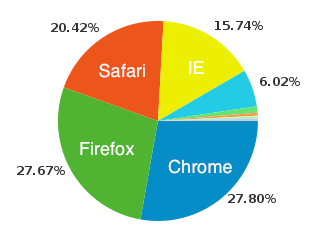
In which TechCrunch tells us about their browser stats. It’s sort of moderately amazing that Chrome is (already) edging out Firefox, but what I find most astounding, the thing that 2003 me would not have believed at all, is that Safari is third. Even more amazing: the article notes that 10% of Safari’s score is coming from the Mobile Safari variant, meaning iOS devices like iPhone and iPad.

tl;dr: Mobile Safari is now within striking distance of IE, and Safari as a whole is cleaning its clock, at least within the obviously gadget-obsessed demographic that reads the source. Let’s all pause to reflect on that for a few moments, because it’s fairly incredible, especially when you count the number of sites (and tech-support scripts) out there still “optimized” for IE6.

Our Ultracapacitave Overlords

Technology Review lets us in on our ultracapacitive future by offering a peep at these super hot buses equipped with, you guessed it, ultracapacitors. The cleverness here is that they get over their short range by charging at special bus stops.

There’s just one catch: the best ultracapacitors can only store about 5 percent of the energy that lithium-ion batteries hold, limiting them to a couple of miles per charge. This makes them ineffective as an energy storage medium for passenger vehicles. But what ultracapacitors lack in range they make up in their ability to rapidly charge and discharge. So in vehicles that have to stop frequently and predictably as part of normal operation, energy storage based exclusively on ultracapacitors begins to make sense.

They tell us about the stops too:

Unlike a conventional trolley bus that has to continually touch an overhead power line, Sinautec’s ultracapacitor buses take big sips of electricity every two or three miles at designated charging stations, which double as bus stops. When at these stations, a collector on the top of the bus rises a few feet and touches an overhead charging line. Within a couple of minutes, the ultracapacitor banks stored under the bus seats are fully charged.

Fantastic. Two minutes at a stop, well, that’s not ideal, but let’s assume that gets better. And, frankly, every agency but the MBTA will set those longer, charging stops at stations that are quite busy (and thus feature longer boarding times) anyway.

But wait, there’s more:

“The ultracapacitor bus is also cheaper than lithium-ion battery buses,” says Ye. “We used the Olympics (lithium-ion) bus as a model and found ours about 40 percent less expensive with a far superior reliability rating.” Ye adds that the environmental benefits are compelling. “Even if you use the dirtiest coal plant on the planet, it generates a third of the carbon dioxide of diesel when used to charge an ultracapacitor.”

And, of paramount interest to the MBTA here in Boston, these super-buses will even fix Routes 1 and especially 39:

There are some other important limitations. The 41-passenger buses, based on current technology, lose 35 percent of their range when air conditioning is turned on, and have weak acceleration.

Holy crap, since 0-60 times will be over 20 seconds, we might just be able to keep to a fucking schedule instead of racing up and down Huntington Ave all the while blaming bunching on “traffic conditions.” We can’t not buy these busses. Today!

This Is Who We Are

Another example of why we fail:

As it happens, Ford, the struggling American car company (in certain ways, probably more centrally “American” to most citizens than even longtime industrial titan GM, nay “The General”), has a new model of the Fiesta coming out that seats five (well, five people the size of Winona Ryder, anyway) and gets 65 mpg. You’re saying “wow, they’ve finally gotten the message and are going to deliver ‘Mericans a car that is relatively inexpensive and gas efficient.”

Except that you’d be wrong. Only selling that car in Europe. You see, it runs on diesel. Ford doesn’t think it can sell enough of the engines (they put the break-even number at 350,000/yr) to warrant building an engine plant (in Mexico, natch); the dollar is just too much of a banana republic currency to merit the importation of the engines/cars from England where they’re made.

All quite sensible. Except that Ford is going to go out of business (at least as we know it today) with this model. Time to bet the company, gentlemen. You are not going to be in a better position to do so next week or next year. As the article notes, VW and Mercedes are investing heavily in clean diesel, as is Nissan. They’ll be first to market in the US, and it is they that will reap the rewards. Create your market. Engage in risk. Figure out a way to sell those 350,000 motors. Otherwise you’ll be a division of Tata motors before you know it.

It seems clear now that it will take the utter obliteration of the US auto industry to save the US auto industry. And, in the not-too-distant future, Silicon Valley will be more associated with cars than Detroit. That’s where people are taking the chances, after all.