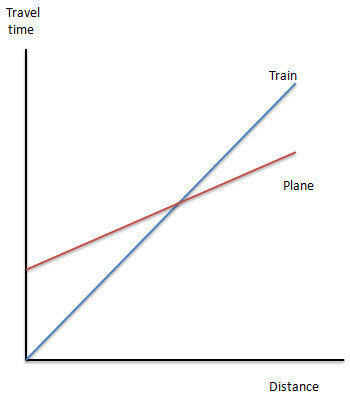
Krugman:

Suppose that I put those fixed costs at 2 hours; suppose that planes fly at 500 miles an hour; and suppose that we got TGV-type trains that went 200 miles an hour. Then the crossover point would be at 667 miles. It would still be much faster to take planes across the continent — but not between Boston and DC, or between SF and LA.

This is just so obviously right, and furthermore strikes me as a prime example of how policy should get made (but too rarely is): empirically. Figure out where those lines cross and then heavily fund everything pre-cross. Just flat out eliminate all other passenger rail until demand is measurably there to support it (ascertained via the same type of calculation). Then the GOP could actually make sense (for once) when they agitate for Amtrak to make money or be eliminated. Instead, they force a vast array of unprofitable routes on it, put the whole of Amtrak’s financial outlook on the back of the northeastern corridor, routinely underfund or defund infrastructure in said corridor, and then wonder why service is relatively slow there and insufficient to turn a profit for the whole rest of the system.

And but also I really think the reflexive GOP train opposition boils down to 1) they perceive it as something that reliably pisses liberals off –and– 2) white suburban conformists in the vast not-the-northeast part of the country just can’t fathom how hard it can be to drive anywhere, much less to set out on the Interstate and face traffic like the western US experiences only in city centers and only at rush hour for the whole X-hundred mile trip. This makes the train seem like the best possible option for many shorter trips. Add that to a predilection for destination cities in which a car is not only unnecessary, but can even be a hindrance and then the true shape of this policy disconnect takes form:
The west sees trains as steam powered slowpokes that drop you off and leave you walking great distances in decidedly pedestrian unfriendly settings. The east sees trains as efficient (and often faster) conveyances that drop you off exactly in the middle of everything, with easier access to the places you are most likely going than you could ever hope to achieve by car.

In this way, both side can’t even fathom the position of the other…and the folks out west go so far as to studiously avoid the train systems when they come east. Even when they move here, they tend to gravitate to the farthest exurb they can find and drive everywhere. This usually boils down to inchoate fear of something with which they have no frame of reference, a well marinated and studiously husbanded fear of the “inner cities,” or just a simple sense of “you drive to work” because that’s what they’ve always done. But, trust me tourists: if you can navigate Boston by car, you sure as hell can use the T. And, as a bonus, you are much more likely to survive.

High Cost of Free Parking

If developers were allowed to face directly the high land costs of providing so much parking, the number of spaces would be a result of a careful economic calculation rather than a matter of satisfying a legal requirement. Parking would be scarcer, and more likely to have a price — or a higher one than it does now — and people would be more careful about when and where they drove.

The subsidies are largely invisible to drivers who park their cars — and thus free or cheap parking spaces feel like natural outcomes of the market, or perhaps even an entitlement. Yet the law is allocating this land rather than letting market prices adjudicate whether we need more parking, and whether that parking should be free.

High Cost of Free Parking

Whither Transit

muppetpants:

Looks like the streetcars have effectively been killed off after already spending millions.  Good news is unallocated funds will go to building playgrounds in Georgetown!

Uh, no. The economic impact of transit construction is well known:

  • According to US DOT director Norman Mineta, every $1 billion invested in the nations’ transportation infrastructure supports approximately 47,500 jobs.
  • Transit capital investment is a significant source of job creation. In the year following the investment 314 jobs are created for each $10 million invested in transit capital funding.
  • Transit operations spending provides a direct infusion to the local economy. Over 570 jobs are created for each $10 million invested in the short run.
  • Tri-Rail of South Florida expects its five-year public transportation development plan to spawn 6,300 ongoing system-related jobs.
  • New York’s East Side Access project is expected to generate 375,000 jobs and $26 billion in wages.
  • In 2000, the average downtown vacancy rate for cities without rail was 12.8%, but 8% for all cities with rail transit.

Playgrounds: not so much. Terrible, terrible decision with far-reaching, all-bad repercussions for the DC economy.

Whither Transit

Choo-Choo-Chooices

Turns out that Amtrak, forced to serve numerous unprofitable and underutilized routes, isn’t making money:

The average loss per passenger on Amtrak’s 44 nationwide routes was more than $32 in FY2008

By my calculations, we pay ~$300 per individual in the entire country to provide the Interstate Highway System. But, by all means, let’s continue treating it as some sort of Heaven-sent resource that we can all use for free while expecting every other mode of transit to earn a healthy profit…or else!

Win one for the Zipper

This is a nice enough idea, separating the battery from the car, linking power generation and distribution, and then essentially selling you the “minutes” rather than just the car and then going your separate ways.

But they need to go one step further. This model won’t scale in the US; we’re too big, too mobile, and nobody is going to stop 18 times to replace a battery just to relocate or haul the family truckster across country (talk about running out of gas; you’d need a forklift to bail you out).

What they need is for a business model here is a sort of Ultra-Zip Car. You don’t buy anything other than a use-privilege. You’re a member, and, in fact, ultimately not that many cars are privately owned. A few gas-powered cars or clean-diesel hybrids are in the fleet for edge tasks that just don’t make sense on 100% electric supply. When you move, you leave the car right where it is. There will be thousands just like it where you arrive. Something like that could genuinely be deal-changing and, over the course of many years, could fundamentally restructure how we think about transportation in this country.

Tie this model to green energy (as they note they’re specifically doing in Denmark) and suddenly you’ve gotten around the generation/distribution connundrum of technologies like wind. Just store it in all the cars and get it back later (if you need it in a pinch) from the cars plugged in. Texas suddenly becomes the Saudi Arabia of wind energy.