You should thank God [for bank bailouts]. Now, if you talk about bailouts for everybody else, there comes a place where if you just start bailing out all the individuals instead of telling them to adapt, the culture dies. There’s danger in just shoveling out money to people who say, ‘My life is a little harder than it used to be,’ […] At a certain place you’ve got to say to [those] people, ‘Suck it in and cope, buddy. Suck it in and cope.’

Charles Munger, billionaire vice chairman of Berkshire Hathaway Inc., in a discussion at the University of Michigan on Sept. 14.

Would be breathtaking if the view weren’t so pervasive. The rest are just smart enough not to say it. We can all rest easy in the knowledge that Charlie will never, ever have to suck it up and cope about anything. Such a thing just wouldn’t be moral.

GSA “Scandal”

Worth noting that the “scandal” eating up several days worth of Congressional hearings cost American taxpayers $823,000. That’s Thousand, with a “t.” Particular interest seems to focus on a single party that cost $1960 dollars. Two thousand dollars.

Bonuses paid post-bailout in AIG’s godforsaken Financial Products Division? $168 million.
Total USG investment in AIG alone: $180 billion. With a B.

That’s just for AIG and really just for one division of AIG. The whole shooting match there on Wall Street was measured in trillions of dollars.

These and other gross mismatches in outrage brought to you by Feckless, the official messaging arm of The Democrat. Well played, boys. Should government money be wasted? Of course not. But let’s keep a sense of scale and focus the outrage on the truly outrageous.

What’s going on here? The answer, surely, is that Wall Street’s Masters of the Universe realize, deep down, how morally indefensible their position is. They’re not John Galt; they’re not even Steve Jobs. They’re people who got rich by peddling complex financial schemes that, far from delivering clear benefits to the American people, helped push us into a crisis whose aftereffects continue to blight the lives of tens of millions of their fellow citizens.

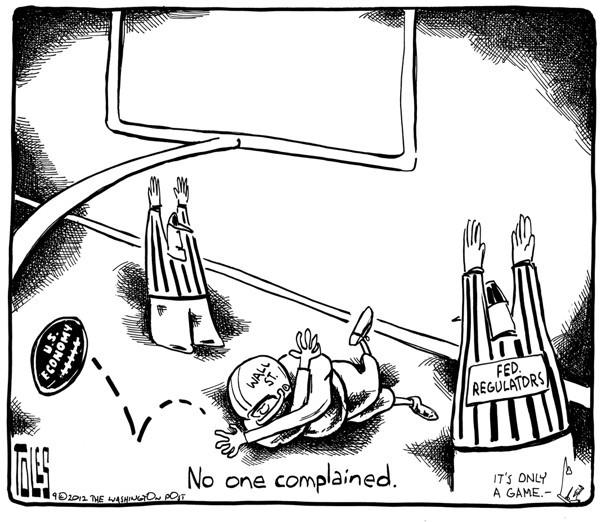
Yet they have paid no price. Their institutions were bailed out by taxpayers, with few strings attached. They continue to benefit from explicit and implicit federal guarantees — basically, they’re still in a game of heads they win, tails taxpayers lose. And they benefit from tax loopholes that in many cases have people with multimillion-dollar incomes paying lower rates than middle-class families.

This special treatment can’t bear close scrutiny — and therefore, as they see it, there must be no close scrutiny. Anyone who points out the obvious, no matter how calmly and moderately, must be demonized and driven from the stage.

Paul Krugman, hosting another edition of Krugman Explains it All in 200 Words or Less. Shrill.

Finally, it is not clear why it views the fact that the [proposed EU financial transaction] tax will make it more difficult to construct trading algorithms as an unintended consequence. These algorithms may provide large profits to the people who develop them, but the benefits to the economy and society are likely to be near zero. If a transactions tax discourages skilled mathematicians and computer programmers from developing complex formulas for financial arbitrage and instead has them work in a productive area of the economy, then the tax will have been a great success.

Dean Baker nails it. The very existence of this sort of trading apparatus, which benefits only the company deploying it, relies entirely on what should be privileged knowledge (e.g. foreknowledge of trade patterns about to happen that can only be extracted and acted upon through either initiating the trade itself or privileged placement of what amounts to a compute cluster on a particular routing switch (or both)), and is the sort of thing used by Goldman et al. to, you know, screw their own customers by trading against their interests and/or simply profiting off what amounts to insider information, is as anti-market, anti-competitive, and the very essence of what all our anti-collusion, anti-insider trading, anti-trust, and anti-monopoly laws are intended to control. And these types of transactions do nothing for the broader economy beyond radically enriching a handful of folks who can only spend so much. And we’re a country with a giant aggregate demand problem. So there’s that.
But may the Flying Spaghetti Monster help anyone who tries to regulate this practice in any way, much less apply a nominal cost to such actions. This, along with rampant and abusive naked shorting, is the true scandal of Wall Street. (By the by: naked shorting is already illegal, but is basically never even investigated, much less litigated. In light of recent events, this should be the basis of a scandal…but that would require a functioning media. Look over there! A missing white woman!)
And, so far as I can tell, exactly zero is being done about any of it. And nothing will be done until after the next financial collapse. And it will only happen then if the collapse is sufficiently devastating that the entire structure of Wall Street finance is utterly laid waste (thus ending their political influence in the aftermath). Sounds like a time.

Default Already Hitting Pocketbooks

The GOP’s hostage taking re: the debt ceiling is already causing ripple effects in the economy:

As of late May, the number of CDS contracts — essentially insurance policies on the possibility of a default — had risen by 82 percent. Equally as important, the cost of a CDS — the best indication of how much riskier U.S. debt has become — rose by more than 35 percent from April to May. Last week I spoke to a number of people who calculate such things for a living, and they said this change means that the interest rate the U.S. government has to pay has already increased by as much as 40 basis points compared with what it otherwise would be. This means higher federal borrowing costs and deficits, and overall higher interest rates on everything from car loans to mortgages to credit cards.

Remember all those “confidence” trolls the GOP trotted out in advance of retaining the Bush tax cuts for the wealthiest individuals in the US? Wonder where those guys went.

But, by all means, let’s talk about Weiner and whatever other body parts are on display in the Halls of Serious People. That’s the stuff that really matters.

Default Already Hitting Pocketbooks

His Master’s Voice

The people actually in charge of Our One True Plutocracy seem to be getting antsy:

House Speaker John Boehner (R-Ohio) has had conversations with top Wall Street executives, asking how close Congress could push to the debt limit deadline without sending interests rates soaring and causing stock prices to go lower, people familiar with the matter said.

[…]

The Wall Street executives say even pushing close to the deadline — or talking about it — could have grave consequences in the marketplace.
“[GOP leaders in Congress] don’t seem to understand that you can’t put everything back in the box. Once that fear of default is in the markets, it doesn’t just go away. We’ll be paying the price for years in higher rates,” said one executive.

Nothing some massive tax cuts couldn’t paper over, right?

His Master’s Voice

Years ago I remember a lot of moderate liberals talking about how the Bush era radicalized them. For me, it was the economic collapse of 2008 that did it. The financial industry almost literally came within a hair’s breadth of destroying the world, but even so it took only a few short months for them to close ranks with Republicans and the rich to prevent anything serious being done to rein them in. Profits are back up, new regulations are barely more than window dressing, nothing was done to help underwater homeowners, bonuses are as obscene as ever, unemployment remains sky high, and the public has somehow been convinced that this was all their own fault — or perhaps the fault of big government, or big deficits, or something. But the finance industry has escaped almost entirely unscathed. It’s mind boggling. If this doesn’t change your view of who really runs the world, I don’t know what would.

‘U.S. Trade Deficit Startles Markets.’ Now, we’ve understood the U.S. trade deficit for a while. Are the markets small children that are easily startled? The next day, they’ll get an unemployment number and go, ‘Oh, I don’t know why we were startled and lost 200 points yesterday; today, we realized the shirt on the chair wasn’t a monster, so we’re going to put 300 points back on the Dow because we’re fucking 5 years old.’

Jon Stewart, scanning the front page of the Washington Post. This simple insight is more than I’ve ever seen mustered from, say, NPR’s Marketplace, a program ostensibly entirely directed at helping people grasp this stuff. If only there were more Mountaintops around.

And now, they’re coming for your Social Security money – they want your fucking retirement money – they want it back – so they can give it to their criminal friends on Wall Street. And you know something? They’ll get it. They’ll get it all from you sooner or later. Because they own this fucking place. It’s a Big Club: and you’re not in it.

George Carlin