The surtax would impact around 345,000 taxpayers, roughly 0.2 percent of taxpayers, or one in 500 of them. Those people would pay on average an additional 2.1 percent of their overall income, or just over 1/50th of that overall income, in taxes.

In a majority of states, only one-tenth of one percent, or one in 1,000 taxpayers, would pay this surtax.

And how many people would benefit from the payroll tax cut? According to the group, around 113 million tax filing units — either single workers or families that include more than one worker — would see their payroll tax cut extended. That’s a lot of people — well over 113 million workers, in fact.

Citizens For Tax Justice runs the numbers on the proposed funding mechanism that would extend the payroll tax “holiday” currently scheduled to end December 31, 2011. I don’t have to remind you that Republicans are categorically against this tax increase, because it harms the “job creators” out there in that 0.2 percent.
The vast majority of the GOP’s 1% constituency wouldn’t even see so much as a dime’s difference, whilst everyone earning a paycheck would stand to receive ~$1000 dollars more in an aggregate demand crisis. So, of course, we prevent the tiny increase for a tiny fraction of the richest people on Earth in exchange for a further insult to our tottering economy when the payroll tax extension is worth ~$250 billion to our economy. Great policy.
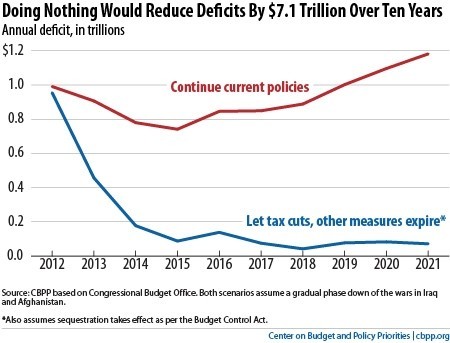
Do nothing, Congress. Ezra Klein and EJ Dionne both write today about the benefits of simply letting various existing policies expire…doing so would net $7.1 TRILLION in deficit savings over the same decade that the “Super-committee” can’t find a way to reliably extract $1T. This path requires no votes, it requires no legislation, it requires no GOP assistance of any kind. Gridlock is all that’s required to make it happen.
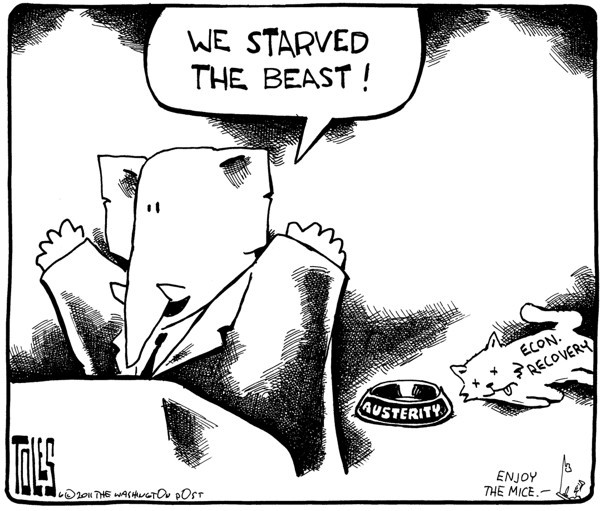
So why is it no Serious Person (to whom deficits are, always have been, and always will be the preeminent policy question come-what-may) ever talks about the biggest deficit reduction plan currently out there, a plan that outstrips all other extant deficit plans by several orders of magnitude? Because they don’t actually care about deficits. None of them do. Because deficit reduction is not the goal. The GOP and their media enablers do not care about deficits. They care about eliminating social spending in this country to lower taxes on the richest 1%. Period. Everything and anything else that happens is collateral damage to that desired policy outcome.

Gridlock works. Gridlock will help America. Relying on gridlock is the best possible negotiating tool for Democrats. Period. Be prepared to end the Bush tax cuts. All of them. Be prepared to end the “doc fix.” All of it. Be prepared to end it all. Then you begin to drive policy decisions and have actual governing authority to get jobs bills and other things done.

Instead, they will, of course, continue to negotiate with themselves and parrot right-wing talking points. This is why they fail.
Just sit there quietly and let it all expire. Whenever the GOP talks about deficits, you bring up the $7T you are cutting deficits by over the next decade.
When the GOP gets tired of that, realizes you are serious about this, and is ready to talk, they’ll come to you. Then you set the terms. Then you begin to govern. This is how politics works. The Democrat seems to have largely forgotten this. Again: this is why they fail.

If this guy prints more money between now and the election, I don’t know what y’all would do to him in Iowa, but we would treat him pretty ugly down in Texas. Printing more money to play politics at this particular time in American history is almost treacherous, or treasonous, in my opinion.

Rick Perry, governor or Texas and candidate for the GOP nomination for President, apparently accusing Federal Reserve chairman Ben Bernanke of treason.
He really is going to invigorate the GOP primary. What a strong field they have.

Obama’s Other Card

Even as the political battle mounts over federal spending, the end result for federal policy is already visible — and clearly favors Republican goals of deep spending cuts and drastically fewer government services.

President Obama entered the fray last week to insist that federal deficits can’t be reduced through spending reductions alone. Federal tax revenue also must rise as part of whatever deficit reduction package Congress approves this summer, he said. Obama has been pushing to end a series of what he calls tax loopholes and tax breaks for the rich.

But even if Obama were to gain all the tax-law changes he wants, new revenue would make up only about 15 cents of each dollar in deficit reduction in the package. An agreement by the Republicans to accept new revenue would be a political victory for Obama because “no new taxes” has been such an article of faith for the GOP.

I think this analysis leaves out a critical piece of the calculation: the December 2012 expiration of the Bush tax cuts. Recall that Obama, above all else, is the “outcomes” President. He’s more than willing to take a temporary political setback or even a seeming political loss in the short term if that in turn leads to the long-term policy outcomes he prefers.

So: to get a deal on the debt ceiling he gives the GOP a fatter ratio of cuts to revenues for now. Keep in mind, these “cuts” are really a framework that then plays out over most of a decade and will ultimately be changed and tuned by several Presidents and Congresses (and that’s assuming they stick to the framework at all).
Next year though, assuming Obama’s reelected, everything changes on the revenue front. If the Congress simply fails to act, the full set of cuts expires. If they act, but the GOP includes extension of the cuts for those making more than ~$200k/yr, Obama vetoes it. And, really, if we assume that the GOP will fail in its efforts to destroy the economy in the next few weeks, Obama likely prefers one of those two outcomes. Why? Again, it’s because they are the best long-term outcomes for the country. That both reflect poorly on the GOP is a bonus side benefit going into the 2014 midterms. To be sure, a tax rise represents real short term pain for the less well off, but that pain yields long term stability and, let’s face it, sanity in the revenue structures of the United States.

Expiration of the Bush tax cuts is a key pillar in the “do nothing” solution for our current deficit/revenue issues. The assumption that all or most of them are going to expire if Obama is reelected needs to be included in any meaningful political calculus regarding the ratio of cuts to revenue increases in the current negotiation. Assuming expiration, you ultimately end up with a number of difficult but doable fixes that can be handled one at a time. If those “fixes” are, you know, paid for, the country will once again be on firm financial footing, complete with a reasonably robust social safety net for as far as the eye can see. This is precisely the outcome Obama is playing for.

Obama’s Other Card

So when the GOP’s economic policy team sat down to make the strongest case they could for growth-inducing deficit reduction, they recommended a mix an 85:15 mix, not a 100:0 mix. And then, when the Obama administration agreed to an 83:17 mix, the Republican leadership walked out of the room and demanded that taxes be excluded from the deal altogether. How do you negotiate with that?

Ezra Klein asks the right questions.

“We’ve known from the beginning that bombing the moon would be a poison pill to any debt-reduction proposal,” Senate Minority Leader Mitch McConnell said in a speech on the Senate floor. See? Or: “President Obama needs to decide between his goal of bombing the moon, or a bipartisan plan to address our deficit,” said McConnell and Sen. on Kyl in a joint statement. Or: “First of all, bombing the moon is going to destroy jobs,“ said Speaker John Boehner. "Second, bombing the moon cannot pass the US House of Representatives — it’s not just a bad idea, it doesn’t have the votes and it can’t happen. And third, the American people don’t want us to bomb the moon.”

Ezra Klein replaces mention of taxes with “bombing the moon” and ends up with a more cogent set of statements.
Also: strangely, he wasn’t going for a Mr. Show reference.

Making it Up

Across several posts, Dean Baker lays into the dread Liberal Media for just plain making it up when it comes to pushing their preferred, center-right “cut deficits now” agenda.

On the Washington Post:

“The national debt will exceed the size of the entire U.S. economy by 2021 — and balloon to nearly 200 percent of GDP within 25 years — without dramatic cuts to federal health and retirement programs or steep tax increases, congressional budget analysts said Wednesday.”

Actually, this is not what the projections showed. The CBO projections showed that if Congress simply followed current law, letting the Bush tax cuts expire, not fixing the alternative minimum tax, and most importantly, allowing the spending caps in the Affordable Care Act (ACA) to remain in place, then the debt to GDP ratio will soon stabilize and head downwards.

On the New York Times:

“The national debt is on pace to equal the annual size of the economy within a decade, levels that could provoke a European-style crisis unless policymakers take action on the federal deficit, according to a report by the Congressional Budget Office.”

This is not true. The CBO report did not warn of “a European-style crisis.” The reason it did not is that a European style crisis does not make sense in the context of the United States. The United States can never be like Greece or Ireland for the simply reason that we print out own currency.

In the event that we actually ran up against serious constraints in credit markets the United States would have the option to have the Fed buy up its debt. Greece and Ireland do not have this option. This could create a risk of inflation, but there is not the risk of insolvency that euro zone governments face.

On NPR:

In the top of the hour news segment on Morning Edition, NPR told listeners that the Congressional Budget Office warned that the national debt will soon equal the annual size of the economy and this could lead to a European-style crisis [see: New York Times above].

This is critically important stuff. Deep cuts right now will strangle the economy and deeply hurt Obama’s chance at reelection to boot. This, coupled with the knowledge that as conditions improve, the ability (in the form of public desire) to make huge cuts to the social safety net will diminish precipitously is precisely why the GOP is for deep cuts now. They know that doing nothing and simply letting the Bush tax cuts expire will do more for improved deficits than almost any of the “plans” on the table. The CBO has said so again and again. These “plans” are not and never will be about the deficit. They are about pushing a preferred social agenda. Period. We just can’t get anyone in the media to break free from their “view from nowhere, compromise must always be the preferable, serious person postion” lens for long enough to get them to even report the simple facts of the case at hand.

tl;dr: We’re doomed. There will be a default. Maybe not this time, but soon. Once you’ve set up the terms of debate such that they always include wrangling over lifting the debt ceiling and treating it essentially as a hostage situation, then you’ve created a system that, sooner or later, someone will push too far for their own purely political purposes. And when that happens it will be the end of America as we’ve known it. And I suspect that will be happening pretty damned soon.

Making it Up

What Ezra Said

Mitt Romney: We have all been distressed by the policies that this administration has put in place over the last two years. We have seen the most anti-investment, antigrowth, antijob strategy in America since Jimmy Carter. The result has been it’s harder and harder for people to find work.
Ezra Klein: By any measure, this is absurd. Taxes are at a 50-year low. The Dow has staged a roaring recovery. Business profits are near record levels. And the economy has gone from losing 780,000 jobs a month to gaining about 160,000 jobs a month. That is to say, it’s getting easier and easier for people to find work, even if it’s not nearly easy enough.

Academic books pack about 600 words to a page. Normal books clock in around 400. Large-print books — you know, the ones for kids or the visually impaired — fit about 250. The House GOP’s jobs plan, however, gets about 200 words to a page. The typeface is fit for giants, and the document’s 10 pages are mostly taken up by pictures. It looks like the staffer in charge forgot the assignment was due on Thursday rather than Friday, and so cranked the font up to 24 and began dumping clip art to pad out the plan.

Ezra Klein reflecting on the GOP “jobs plan.”