Confessions of a Climate Convert

Forget all the road to Damascus stuff in the piece, this is what I find important:

I’d argue that conservatives and libertarians should strongly support regulation to reduce carbon pollution, since pollution by one entity invariably infringes upon the rights of others (including property rights), and no entity has a constitutional right to pollute. It does not put America on the road to serfdom to suggest that the federal government has a compelling interest in protecting the country from ecological damage. If anything, it puts America on the road to common sense.

Exactly right. This is how Democrats should be messaging on this issue. It removes the ever-present and undeniable impulse in the MSM to punch the dirty fucking hippies whenever possible, the nigh irresistible impulse to note that it “snowed today,” and the much beloved “well, Al Gore sure is fat” gambit and frames the debate in terms even libertarians can understand.

Part Two of said strategy needs to incorporate the notion that even if we’re 100% wrong these measures will be good for the country and likely even of existential importance relative to our industrial and economic standing in the world. Getting off our oil addiction is, plain and simple, a good idea, no matter what you think the output carbon of our oil economy is doing. We’re going to be getting off of oil sooner or later, may as well start now and be the arbiter or at least one of the arbiters of the post-oil economy. Furthermore, if you want America “making things” again, the most likely and highest value target for said industry is in the post-oil transition. Not only can you sell such technology to the developed world, the whole of the developing world will be knocking at your door as well.
There is not enough reserve oil in American hands to measurably move the global market, even if we could extract it all tonight. There just isn’t. We wouldn’t even make an appreciable impact on our own rate of import were we to employ all of our oil; even that small but measurable impact would only last for a year or two. We may hold 1-2% of proven world reserves. Period. We cannot and will not ever produce our way off of foreign oil. It is simply not possible given current or projected usage. And, oh by the way, there isn’t enough global capacity either, though only the US military seems willing to admit it publicly.
The time to start dealing with both the implicit misconception (Drill baby drill!) and the overriding and much more important harsh reality is right now, not 20 years from now when our oil addiction and its impacts is both (still) utterly undeniable and but it is also too late to do anything about it.

Confessions of a Climate Convert

The people most affected by [the drug war] are black and brown and poor. It’s the abandoned inner cores of our urban areas. As we said before, economically, we don’t need those people; the American economy doesn’t need them. So as long as they stay in their ghettos and they only kill each other, we’re willing to pay for a police presence to keep them out of our America. And to let them fight over scraps, which is what the drug war, effectively, is. Since we basically have become a market-based culture, that’s what we know, and it’s what’s led us to this sad dénouement. I think we’re going to follow market-based logic right to the bitter end.

…the most plausible deficit reduction plan is to rely on gridlock rather than cooperation. Obama yesterday held absolutely firm in his opposition to extending tax cuts on income over $250,000. If Obama won’t relent, then Republicans probably won’t relent on the rest of the tax cuts, and the whole thing will expire. And then, if Obama wins reelection, he’ll be most of the way toward a sustainable deficit, and the Republicans will have had their triumphalism beaten out of them. At that point, a deal to raise a little revenue by reforming the tax code plus spending restraint would be far more plausible.

Jonathan Chait, seemingly forgetting the part where Obama gets to campaign on the GOP eliminating tax cuts for the middle class because they weren’t getting tax cuts for the very richest of the rich. Who, you know, only destroyed the global economy and aren’t the most popular folks electorally. But by all means, GOP, campaign on an all fat-cat ticket. It’s working out great so far in the Midwest.

Mr. Boehner may face just as much risk as Mr. Obama, if not more. He has promised his more conservative members that he will extract significant concessions from the Democrats before he agrees to an increase in the debt limit. A White House that was willing to play hardball could put him to the test, and perhaps cause a substantial loss of face.

[…]

If Mr. Obama is a good poker player, he’ll know not to disregard Mr. Boehner’s earlier rhetoric, which gave away the vulnerability of his hand. And he’ll recognize Mr. Boehner’s more recent and more confident rhetoric for what it is: the oldest “tell” in the poker book, a show of strength betraying the ultimate weakness of his position.

Nate Silver
Mr. Obama is most decidedly not a good poker player.

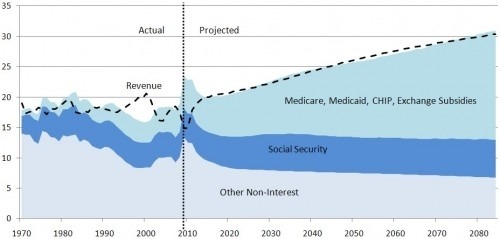
As Ezra Klein suggests, all economic conversations should begin (and end) with this graph. If we do nothing, the budget comes basically into balance:

But nothing is hard to do. This nothing, for instance, includes three crucial elements: (1) All the Bush tax cuts expire, as they’re currently scheduled to do; (2) The Medicare doc fix is either implemented or its repeal is paid for over the next 70 years; and (3) the Affordable Care Act is implemented, and all of its spending targets are met and all of its taxes are collected.

I’ll wager 1 million dollars that this topic or any discussion even remotely resembling it comes up exactly zero times in Obama’s Wednesday remarks.

It’s short, it’s simple, it’s understandable, and it’s true. All good reasons it won’t be used to bludgeon the GOP in the run-up to 2012.

It’s going to be just like the Social Security fight, only worse: once again, Very Serious People will pretend not to notice that the Republican plan is a giant game of bait-and-switch, dismantling a key piece of the social safety net in favor of a privatized system, claiming that this is necessary to save money, but never acknowledging that privatization in itself actually costs money. And we’ll have endless obfuscation, both-sides-have-a-point reporting that misses the key point, which is that the putative savings come entirely from benefit cuts somewhere in the distant future that would, in all likelihood, never actually materialize. (What do you think will happen when retirees in 2025 discover that their Medicare vouchers aren’t enough to buy insurance?)

Paul Krugman, on the coming Medicare privatization fight. Add to that an administration that has shown zero interest in coming out of a defensive crouch on such issues, even when 87% of Americans favor keeping Medicare as is or increasing funding.
And, just to get a sense of where the MSM and its serious people are going to come down on the issue, you might review how that overwhelming majority of Americans favoring the continuation and expansion of Medicare is played. tl;dr: second to last paragraph, after about 17,000 words on how Americans “flunk” the budget test. Newsflash, CNN: your own poll shows they know that Medicare is relatively costly; however, they see the value of not putting folks over 65 out there on a competitive market with a fixed amount of 2010 dollars with which to try and find care. But, by all means, journalistic integrity means playing up that folks overestimate our outlays in foreign aid as a cudgel against their views on (and apparently clear understanding of) Medicare funding. Might those sad rubes out there in the many diners of flyover country be conflating military spending with “foreign aid?” We shall never know.
It aint going to be pretty.

Years ago I remember a lot of moderate liberals talking about how the Bush era radicalized them. For me, it was the economic collapse of 2008 that did it. The financial industry almost literally came within a hair’s breadth of destroying the world, but even so it took only a few short months for them to close ranks with Republicans and the rich to prevent anything serious being done to rein them in. Profits are back up, new regulations are barely more than window dressing, nothing was done to help underwater homeowners, bonuses are as obscene as ever, unemployment remains sky high, and the public has somehow been convinced that this was all their own fault — or perhaps the fault of big government, or big deficits, or something. But the finance industry has escaped almost entirely unscathed. It’s mind boggling. If this doesn’t change your view of who really runs the world, I don’t know what would.

Not Equal to the Challenge

John McCain, 2008: We stand warned by serious and credible scientists across the world that time is short and the dangers [of climate change] are great. The most relevant question now is whether our own government is equal to the challenge.
John McCain, 2010: It’s an inexact science.
Ezra Klein, 2011: I take that as an exact answer to McCain’s original question: No, our government is not equal to the challenge.
Lemkin: The moment people are even one one hundredth as irrationally terrified of carbon emissions as they are of dread “radiation” (regardless of source, quantity, exposure, time, distance, shielding, or any other mitigating factor: sweet merciful Flying Spaghetti Monster, it’s RADIATION!!!!!) then we’ll be getting somewhere on the issue. Until then: Al Gore is fat. It snowed today. And etc… The fact is: carbon emissions (and the associated other outputs of fossil fuel use) have a real, daily, and quantifiable health impact upon us all over and above the impacts on the broader global environment. That’s a collective impact that is almost certainly immeasurably greater in terms of real damage to lives, lifespan, and property than that of all nuclear accidents everywhere and forever combined. But, hey: Charlie Sheen everyone!