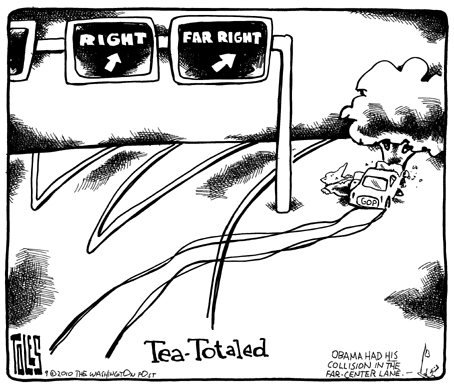
What business should want, in theory, is a Republican Party that advocates for its interests. That is to say, a Republican Party willing to send 20 senators and 50 House members to the table when Democrats are writing a huge health-care bill that has the votes to pass. The Democrats would’ve given anything for some votes from across the aisle, and whatever it is that business wanted, it could’ve gotten. But since the Republican Party wasn’t interested in governing or negotiating, business didn’t have that leverage. Insofar as the GOP is the party of business, they failed their constituents: They neither stopped the bill nor – with the exception of Olympia Snowe – fully participated in the process behind it. Or take the stimulus bill, which major business groups like the Chamber of Commerce supported, but which the Republicans abandoned.
Tag: yep
We are starting to wonder whether Congressional Democrats lack the courage of their convictions, or simply lack convictions.
Wait, starting? At any rate, we should really just buck up and quit whining about it.
I support tax increases that will reduce my own after-tax income; I worry greatly about unemployment, even though my own living is secure; I warn about growing inequality, even though I’m of the class that has gained from rising disparities; I’m upset about the direction this country is going, even though my own life is comfortable. And this is supposed to cast doubt on my motives?
This is a news article about a scientific paper
This is the descriptive tag for my excerpt that I include such that you will (hopefully) click on through:
To pad out this section I will include a variety of inane facts about the subject of the research that I gathered by Googling the topic and reading the Wikipedia article that appeared as the first link.
I will preface them with “it is believed” or “scientists think” to avoid giving the impression of passing any sort of personal judgement on even the most inane facts.
This fragment will be put on its own line for no obvious reason.

Here’s an idea: MAKE THEM VOTE
…the best way for Dems to nationalize the elections right now is for Congress to hold a vote on whether to extend the middle class tax cuts. If Dems did this, it would reinforce the national strategy that Dems already have in place: Making the case that a vote for the GOP is a vote to return to the Bush policies that ran the economy into the ground.
Indeed, we’re finally seeing polling evidence that voters are beginning to buy the core Dem message that the GOP wants nothing more than a rapid restoration of Bush’s policies. Is it an accident that this is happening right when the debate over the Bush tax cuts is dominating the news? Doubtful. And holding a vote on whether to extend the middle class tax cuts would dramatize the contrast between the national parties even more cleanly, forcing lawmakers to go on record choosing between Obama tax policy and Bush tax policy. Put simply, there is no better way of driving home the Dems’ core message than to hold this vote.
There is no policy that President Obama has passed or proposed that added as much to the deficit as the Republican Party’s $3.9 trillion extension of the Bush tax cuts. In fact, if you put aside Obama’s plan to extend most, but not all, of the Bush tax cuts, there is no policy he has passed or proposed that would do half as much damage to the deficit. There is not even a policy that would do a quarter as much damage to the deficit.
Yep. And, if you’re The Democrat, you shall never speak of this. Ever. Too complicated, apparently.

Some people have already asked how an American like D’Souza disparages anti-colonialism, but it’s simple really: African self-determination is seen by many in the West, particularly conservatives, as tragic in comparison to the idealized “stability” of white rule. “Kenyan anti-colonialism” manages to say at once that Obama is a black, incompetent despot who is out for revenge against whites and who will destroy the country in the process. This is profoundly racist on its face. Yet it’s the cover story in Forbes magazine.
People who talk about our “materialistic society” and about getting back to “spiritual values” strike me as having a right sense of indignation and a poor sense of analysis. The delusion of our society is not so much its materialism as its faux spiritualism, its desire to make a heaven on earth, not as a place free of needless suffering and full of what Barbara Ehrenreich calls “collective joy,” but as one in which the elect live everlastingly and communicate telepathically while flying in disembodied splendor above the heads of the Mexicans mowing the lawn.